Static vs Dynamic Ads: Differences, Costs, and When to Use Each
July 23, 2026 · AskEditor Team · 8 min read
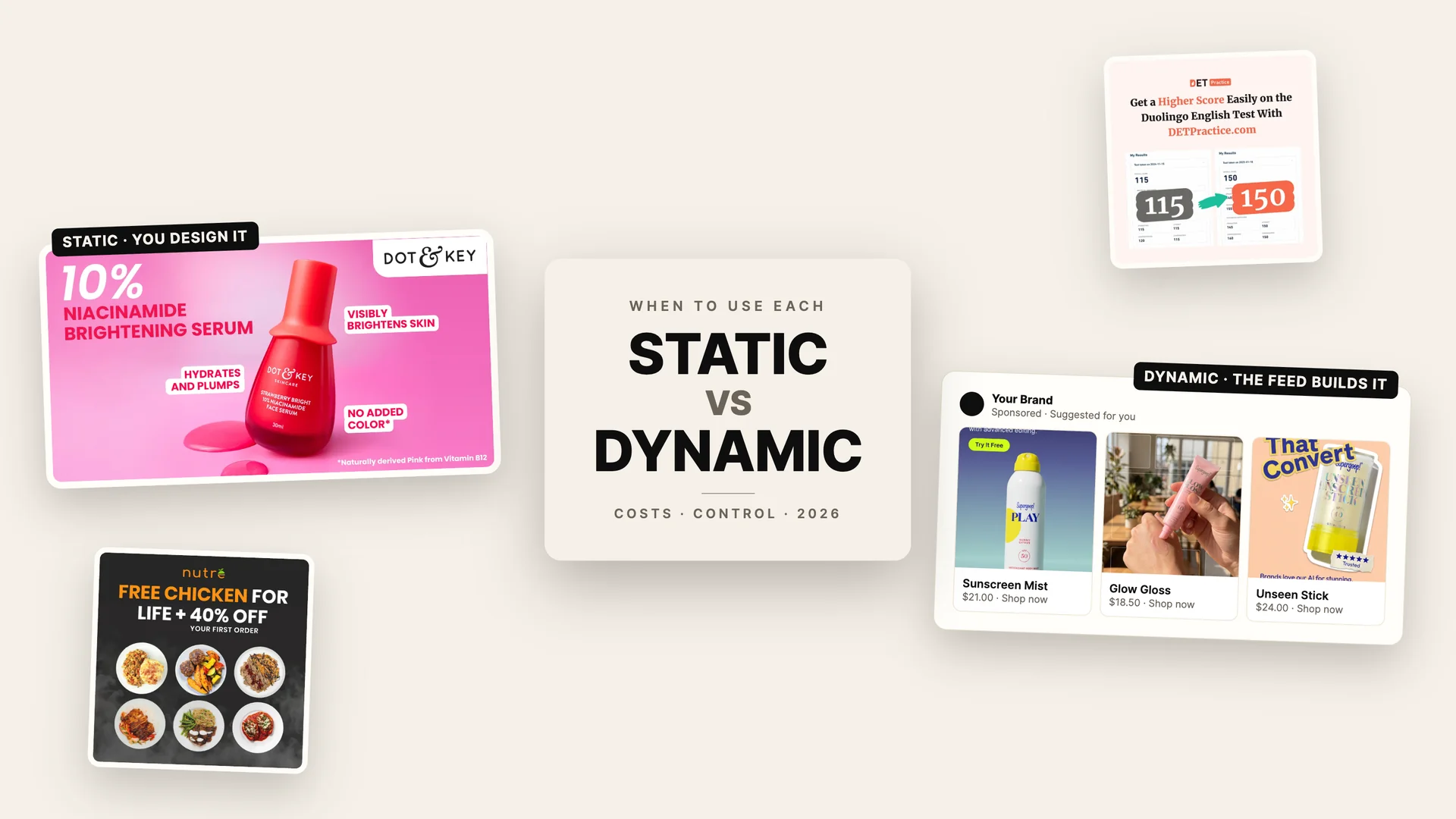
Static vs dynamic ads, settled honestly: costs, production time, performance, and a decision tree for when each format earns its budget.
Table of contents
The static vs dynamic ads question decides more media budgets than almost any other creative choice, and most teams answer it by habit. Static feels cheap and safe. Dynamic feels advanced, so it must be better.
Both instincts are wrong often enough to cost real money. The right answer depends on your catalog size, your funnel stage, and how quickly you need to test new angles.
This guide gives you the comparison most format debates skip: a 12-point table, a decision tree, and a clear rule for when to run each.
Key Takeaways
- Static ads win on production speed and creative control, which makes them the default format for prospecting and for testing new angles.
- Dynamic ads win when a product feed can do the targeting work, which makes them the default for retargeting catalogs of 20 or more products.
- The static vs dynamic ads decision is rarely either-or, because the highest-performing accounts run static creative for cold traffic and dynamic ads for warm.
The Short Answer
Static ads are fixed image creatives you design once and control completely. Dynamic ads assemble themselves from your product feed, showing each viewer the products they browsed. Use static for prospecting and creative testing, dynamic for retargeting larger catalogs, and expect to run both.
That is the 40-word version. The rest of this guide explains where each format actually earns its budget, because the details change the answer for some businesses.
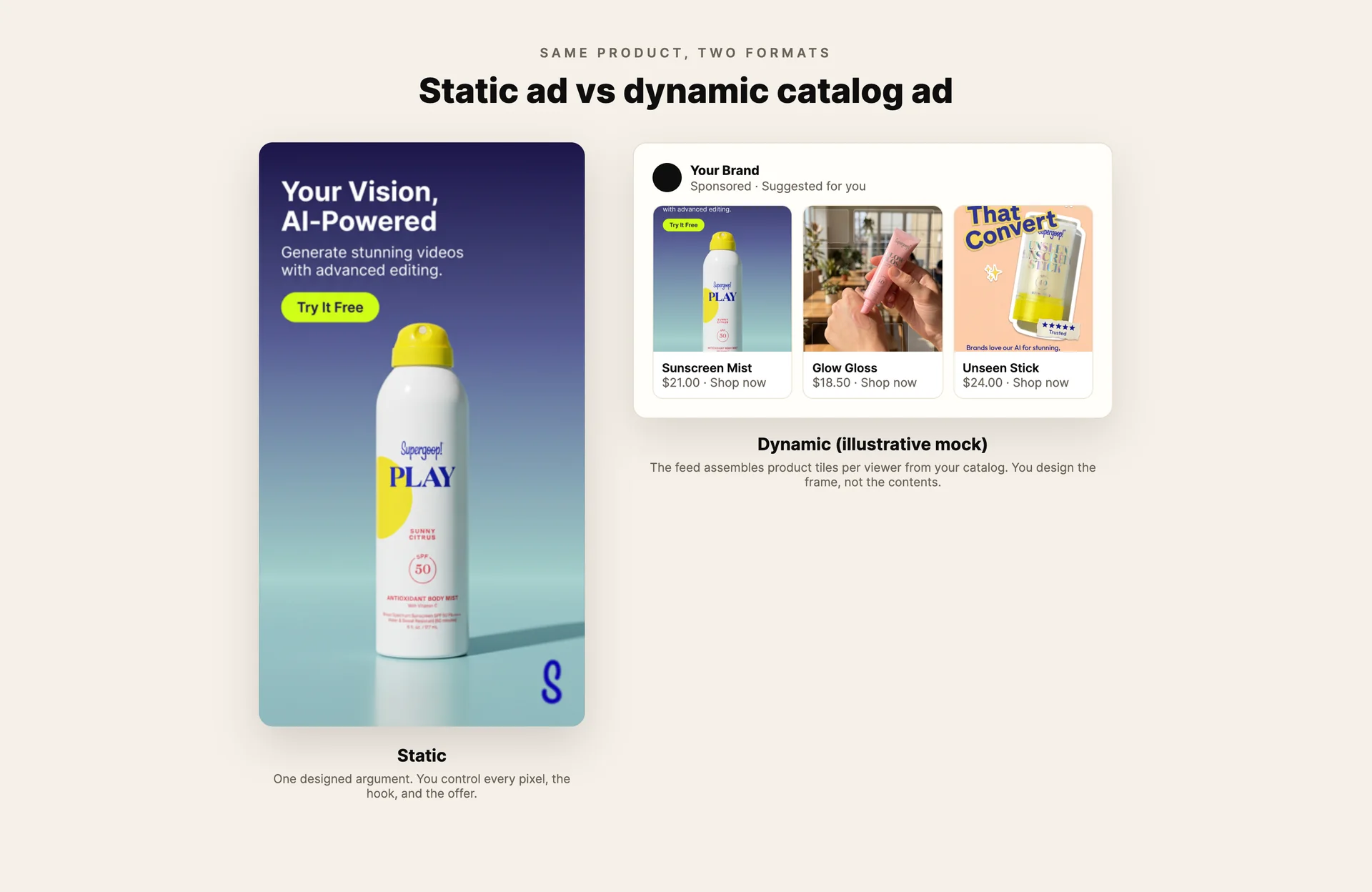
One designed argument versus a feed-assembled catalog carousel (illustrative mock).
Static and Dynamic Ads, Defined
A static ad is a single fixed image: one visual, a headline, and a call to action, usually delivered at 1080 by 1080 pixels for feed placements or 1080 by 1920 for Stories. Nothing about it changes between viewers. What you approve is exactly what every person sees.
A dynamic ad is a template plus a data feed. On Meta these are Advantage+ catalog ads, and Google runs the same idea through dynamic remarketing. You upload a product catalog, the platform's pixel tracks what each shopper viewed, and the ad slot fills itself with those products, their prices, and their names. You design the frame. The feed supplies the contents.
The setup cost difference is real. A static ad needs an image. A dynamic campaign needs a maintained product catalog, pixel or SDK events wired to product IDs, and enough traffic for the personalization to matter.
Static vs Dynamic Ads: The 12-Point Comparison
| Dimension | Static ads | Dynamic ads |
|---|---|---|
| What it is | One fixed image, designed by you | Template auto-filled from a product feed |
| Production time | Minutes to hours per creative | Days to set up feed, template, and events |
| Cost to produce | Low: design time only | Higher upfront: catalog, pixel, template work |
| Creative control | Total control over every pixel | Partial: layout yes, contents no |
| Personalization | None: everyone sees the same ad | High: each viewer sees products they browsed |
| Setup requirements | An image and an ad account | Catalog, pixel events, matching product IDs |
| Best funnel stage | Prospecting and cold traffic | Retargeting and warm traffic |
| Creative fatigue | Fatigues fast, refresh often | Self-refreshing as the feed rotates products |
| Testing speed | Test a new hook the same day | Slow: template changes affect everything |
| Minimum catalog size | Works with a single product | Needs roughly 20+ SKUs to pay off |
| Copy control | Exact headline and text, always | Pulled from feed titles, quality varies |
| Where it breaks | Manual refresh burden at scale | Thin catalogs, broken feeds, bad product data |
Two of these rows decide most arguments. Testing speed is the quiet advantage of static: when a hook stops working, you can have a new angle live the same afternoon. In our own runs, generating a five-creative static set with AskEditor's static ad generator takes about four minutes, which changes the testing math entirely.
The other deciding row is minimum catalog size. Dynamic ads are a machine for matching many products to many browsing histories. Give that machine three products and it has nothing to personalize. Same product. Different rules.
When to Use Each: A Decision Tree
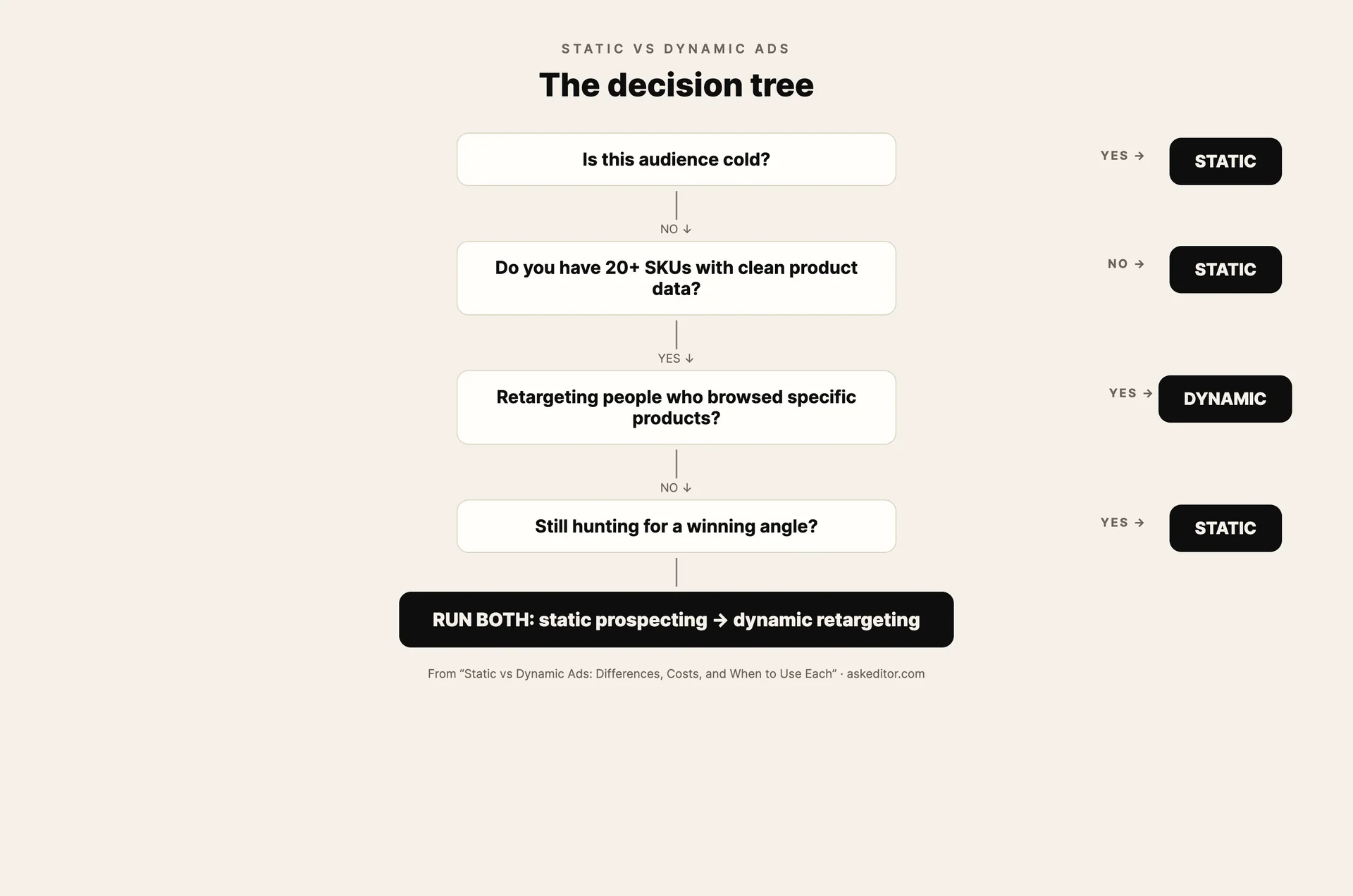
Four questions settle most static vs dynamic budget arguments.
Walk your situation through four questions:
- Is this audience cold? If they have never seen your brand, run static. Cold prospects need a designed argument with a hook and one clear offer, and that is exactly what a fixed creative delivers. Dynamic ads showing random catalog items to strangers waste the personalization they were built for.
- Do you have 20 or more SKUs with clean product data? Below that line, dynamic setup effort rarely returns its cost. A three-product brand gets more from three strong statics than from a feed template.
- Are you retargeting people who browsed specific products? This is the dynamic sweet spot. Someone who viewed a product and left responds to seeing that exact product again, with its real price, without a designer touching anything.
- Are you still hunting for a winning angle? Stay static until you find it. Angle testing needs cheap variants you fully control, shipped the same day, and statics are the only format that delivers that.
If you sell one hero product, the tree is short: static everywhere, with retargeting statics that hit objections instead of showing a catalog.
Why the Real Answer Is Usually Both
The accounts that scale treat the two formats as a relay, and the handoff point is intent.
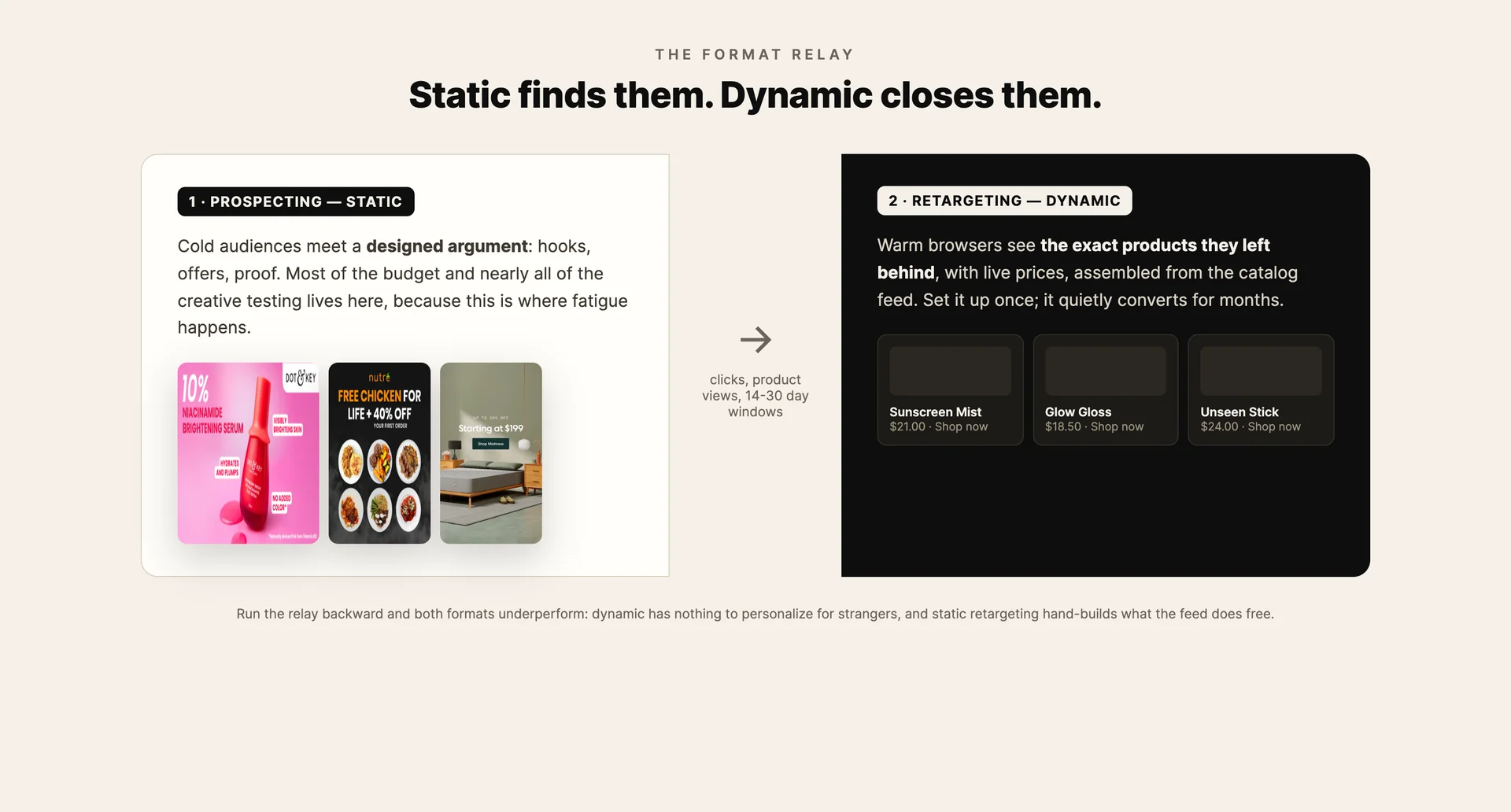
The relay in one picture: designed statics win the click, feed-built dynamics close the browsers.
Static creative runs at the top: hooks, offers, before-and-after frames, testimonial layouts. Its job is to earn the click and the product view. Dynamic catalog ads run behind it, catching the people who viewed products in the last 14 to 30 days and closing them with the exact items they left behind.
This split also explains the budget pattern you see in mature accounts. Prospecting gets most of the spend and nearly all of the creative iteration, because that is where fatigue lives. Retargeting gets a stable dynamic campaign that runs for months untouched, quietly converting the traffic the statics bought.
Run the relay in the other direction and both formats underperform. Dynamic ads to cold audiences personalize on browsing history that does not exist, and static-only retargeting forces you to hand-build what a feed would do for free.
Carousel and Animated Ads: Where They Fit
Carousel is a layout, and it comes in both flavors. A manual carousel is a static ad with more panels: you design every card, which makes it a storytelling format for cold traffic. A dynamic carousel is feed-filled and belongs in retargeting with the rest of your catalog machinery.
Animated ads (GIFs and lightweight motion graphics) sit between static and video. They lift attention in crowded feeds and cost more to produce and refresh. The practical rule most buyers land on: prove an angle works as a static first, then pay for motion on the winners only. Animating a loser makes a more expensive loser.
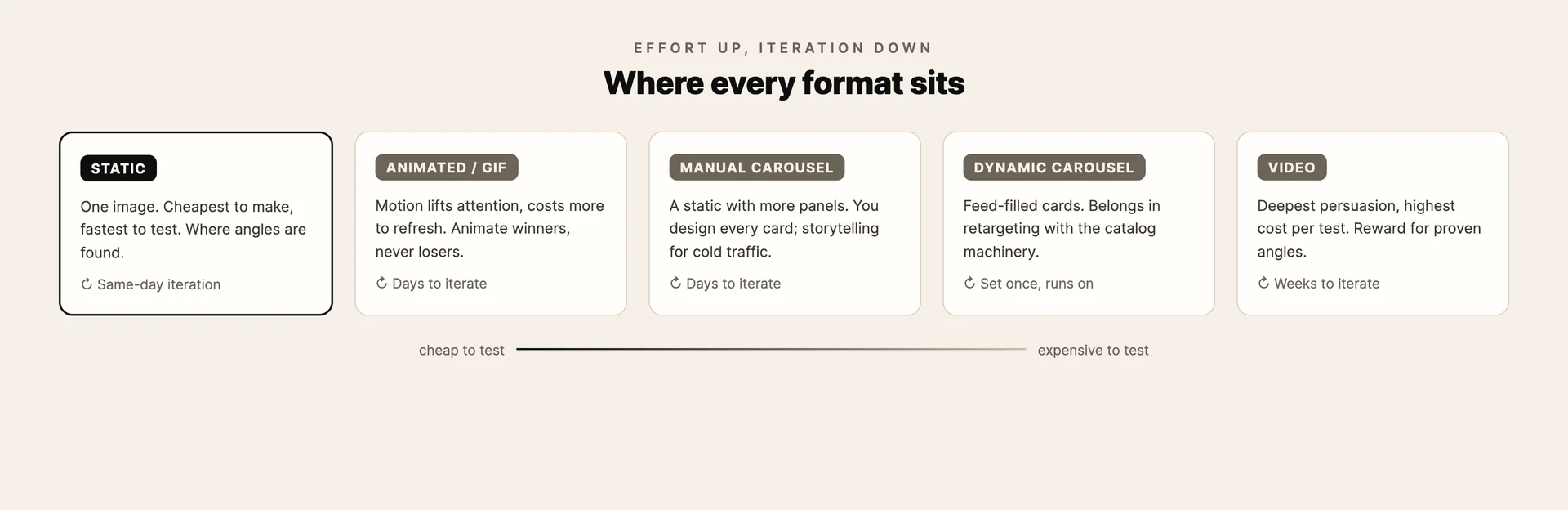
The full format spectrum: cheap to test on the left, expensive to test on the right.
Frequently Asked Questions
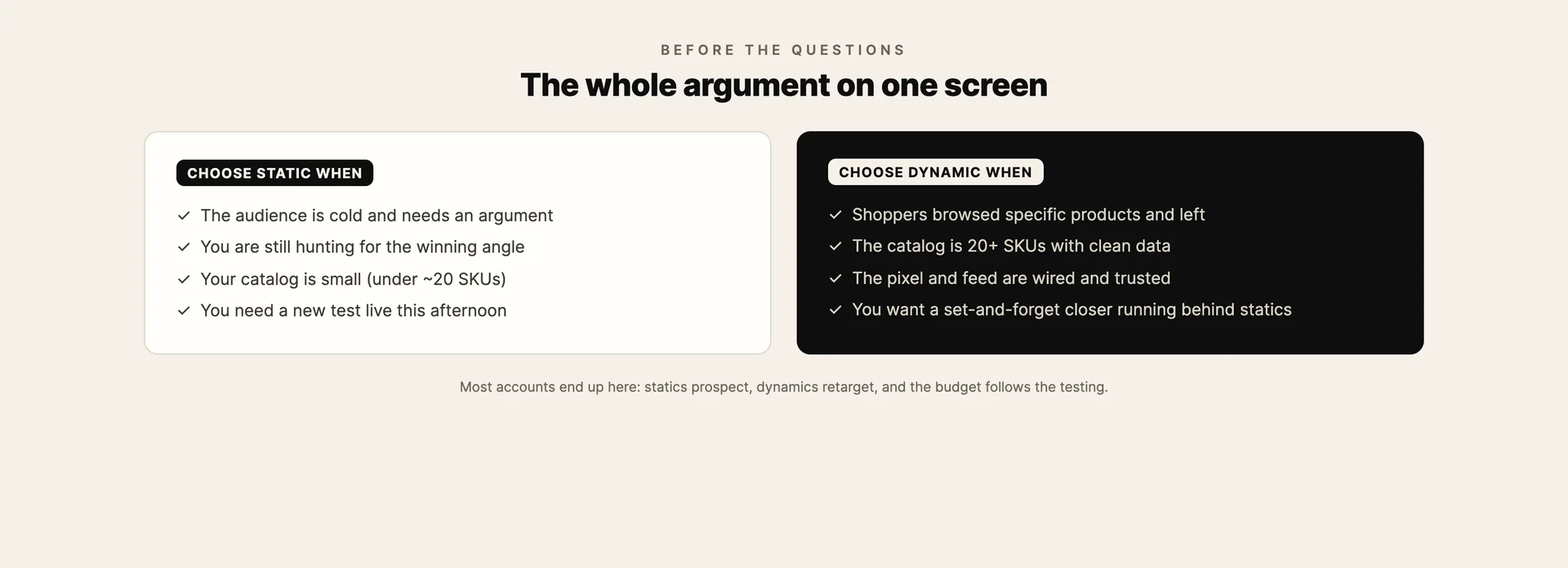
The whole decision on one screen, before the fine print.
Are static or dynamic ads cheaper? Static ads are cheaper to produce, since a single image needs only design time. Dynamic ads cost more to set up but almost nothing to maintain, because the feed refreshes the creative for you. Platforms charge the same auction prices for both, so the cost difference is entirely on the production side.
Do dynamic ads perform better than static ads? Only where personalization has data to work with. In retargeting, dynamic ads usually beat generic statics because they show each shopper the products they already viewed. In prospecting, statics usually win, since cold audiences have no browsing history to personalize against.
Can you A/B test dynamic ads? You can test templates and audiences, but you cannot control which products appear for which viewer, so creative-level testing is limited. Angle and hook testing belongs to static ads, where every variable is yours.
Do static ads still work in 2026? Yes, and they remain the majority of prospecting creative on Meta. Fixed images load instantly, communicate one offer clearly, and can be produced in volume for testing. For proof, browse our 25 static ad examples that have been running for months and, in one case, years. AI generation has made that volume cheaper, which has pushed statics up rather than out.
What size should a static ad be? Use 1080 by 1080 pixels for feed placements, 1080 by 1920 for Stories and Reels, and 1200 by 628 for link and display placements; the current numbers for every platform are in our static ad specs guide. Generating each concept in all three ratios costs little and saves the placement-cropping problems that crush click-through rates.
The Bottom Line
Static vs dynamic ads is a funnel question wearing a format costume. Fixed creatives argue your product into a stranger's attention, and feed-driven ads close the people who already looked. Pick based on catalog size and traffic temperature, and the argument mostly resolves itself.
The bottleneck that remains is producing enough static variants to keep testing, and that is now the easiest part to fix: paste your product link into AskEditor's static ad generator and get an on-brand, ready-to-run set in minutes.
AskEditor Team
Guides on making marketing video with AI, from the team building AskEditor.