Static Ad Sizes and Specs for Every Platform (2026 Tables)
July 23, 2026 · AskEditor Team · 11 min read
Static ad specs for Meta, LinkedIn, TikTok, Pinterest, Reddit and X, verified against official docs: sizes, file limits, character counts and safe zones.
Table of contents
We sat down on July 23 to double-check one number, Meta's recommended feed size, and ended up rewriting our entire internal cheat sheet. The 1080 x 1080 square everyone still designs to? Gone from Meta's own Facebook feed page. The current recommendation is 4:5 at 1440 x 1800. X quietly started accepting 4:5 and 2:3 creatives back in February. Most spec roundups you'll find have noticed neither.
So this page exists to be the one we wished we'd found: all the static ad specs below checked against official platform documentation on the same day, with a flag wherever a platform hides its docs or contradicts itself. And a couple of them do.
A quick note on method, because the method is the whole product here. We open each platform's official spec page and write down what it actually says today, not what last year's roundups keep repeating at each other. When two official Meta pages disagree (happens more than you'd think), we tell you which one is current. When a platform hides its docs behind a login wall, we mark the number as consensus instead of pretending we read something we didn't. The check re-runs monthly. Two of these nine platforms changed their core recommendation inside a year, so a spec page that isn't re-verified is just a rumor with a table.
Key Takeaways
- Two masters carry most static ad specs in 2026: a 4:5 at 1440 x 1800 and a 9:16 at 1440 x 2560. Between them you have Meta feed, Stories, Reels, and everything X started taking in February.
- Watch the file ceilings, not just the pixels. Google banners choke past 150 KB while Meta happily swallows 30 MB, so one export preset is a fantasy.
- Every platform accepts far more copy than it displays. Write to the visible number, because the cut lands exactly where your click was supposed to happen.
The One-Table Cheat Sheet
| Platform | Primary size (ratio) | File | Copy that actually shows |
|---|---|---|---|
| Facebook feed | 1440 x 1800 (4:5) | JPG/PNG, 30 MB | Primary text 50-150 chars, headline 27 |
| Instagram feed | 1440 x 1800 (4:5) | JPG/PNG, 30 MB | Primary text 125 chars, headline 40 |
| FB/IG Stories + Reels | 1440 x 2560 (9:16) | JPG/PNG, 30 MB | 125 chars (Reels: 44) |
| LinkedIn single image | 1200 x 628 (1.91:1) or 1200 x 1200 (1:1) | JPG/PNG/GIF, 5 MB | Intro 150 chars, headline 70 |
| TikTok carousel | 1080 x 1920 vertical cards, 2-35 images | JPG/PNG, keep cards light | One caption + one CTA for all cards |
| Pinterest pin | 1000 x 1500 (2:3) | JPG/PNG, 20 MB | Title: first 40 chars show |
| Reddit image post | 1080 x 1080 (1:1) or 1080 x 1350 (4:5) | JPG/PNG/GIF, ~3 MB | Title readable to ~80 chars |
| X image ad | 1200 x 628 or 1080 x 1080; 4:5 and 2:3 now work | JPG/PNG, 5 MB | 280 chars, URLs cost 23 |
| Google Display (RDA) | 1200 x 628 + 1200 x 1200, no portrait | 5,120 KB per asset | 5 headlines x 30, long headline 90 |
Came just for the table? You're done, go make ads. Everyone else: the minimums, safe zones, and the weirder traps live below, and a few of them are worth the scroll.
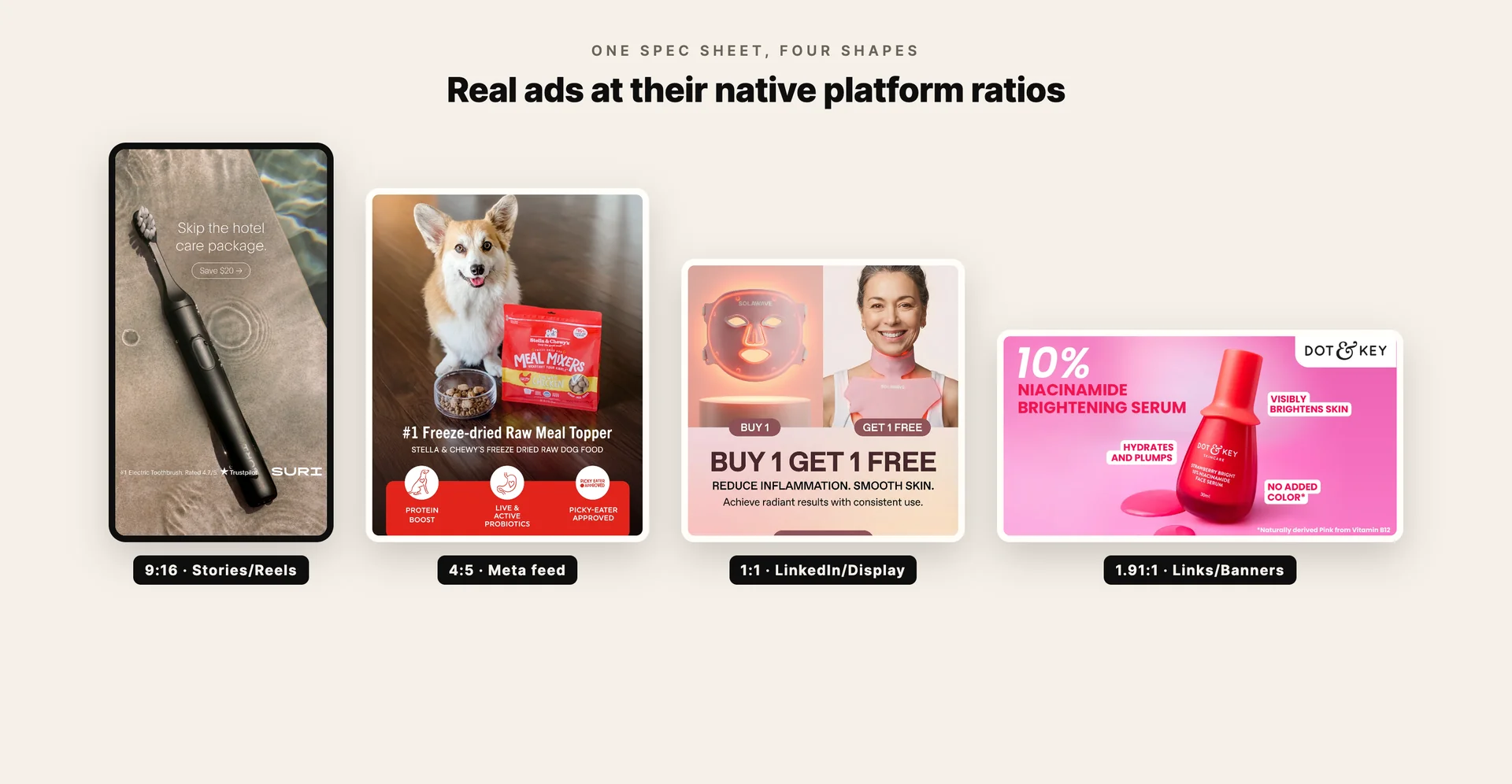
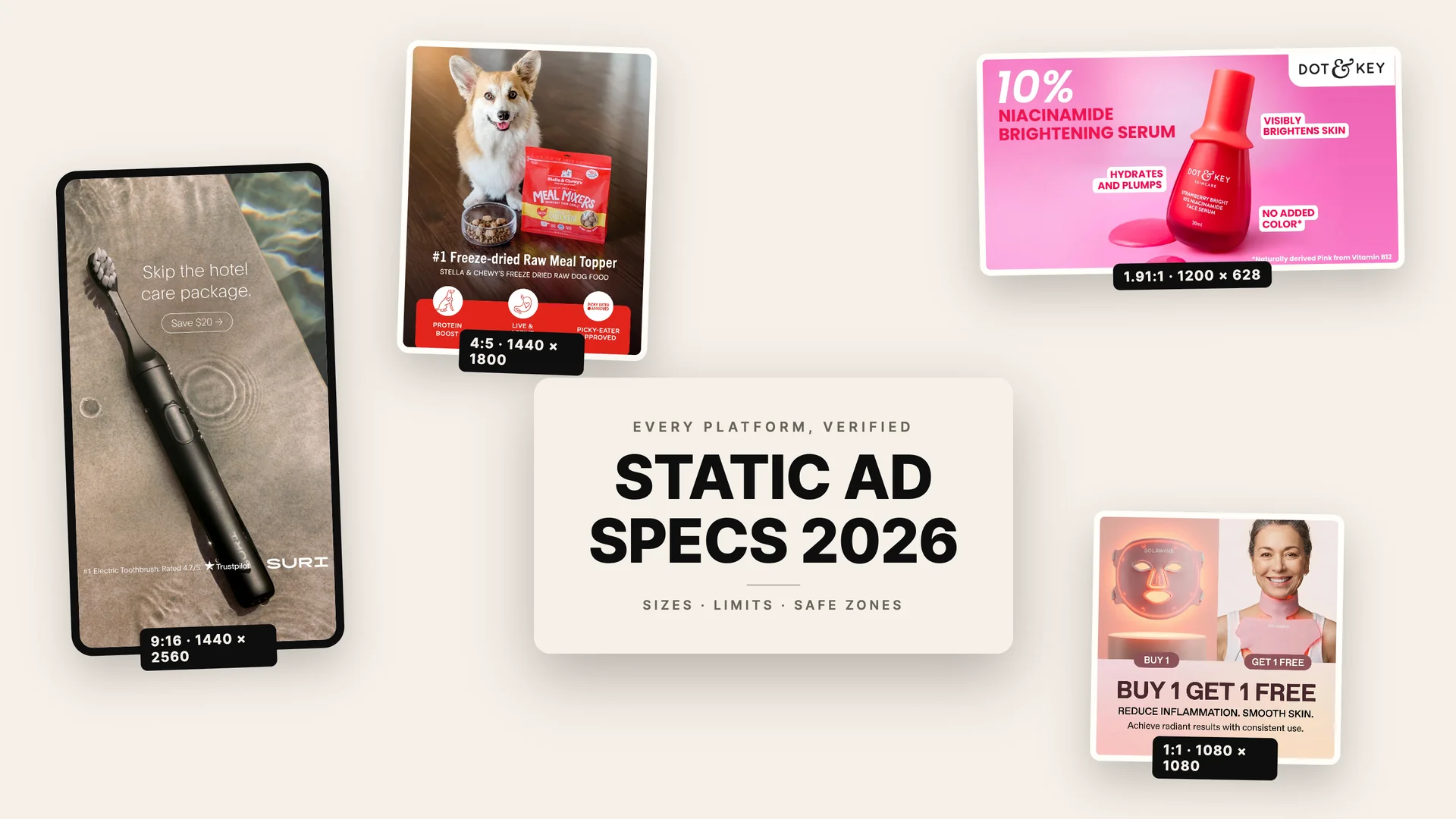
Four ads from our 25 static ad examples, each at its platform's native ratio. Different shapes are different compositions, not crops.
Meta Static Ad Specs: Facebook and Instagram
Start with the change that made us rewrite this page. Facebook feed wants 4:5 now. Meta's own guide says 1440 x 1800 and will accept a JPG or PNG up to a frankly comedic 30 MB. Headlines still chop at 27 characters. The primary text guidance got vaguer too; where the old page said 125 characters, the new one shrugs and offers "50 to 150." Go taller than 4:5 and the feed crops you; go wider than 1.91:1 and the upload just bounces. If you came here for the Facebook static ad size in one line: 1440 x 1800, 4:5, done.
Instagram's page is close to a copy-paste of Facebook's, save a 40-character headline and room for 30 hashtags. Please don't use 30 hashtags.
And the famous 125-character "See more" cutoff? Meta quietly stopped publishing it. In our experience the number still roughly holds on mobile, though it drifts by device. Front-load the hook; whatever survives past the first line is a bonus.
The 9:16 safe zone, which is where good ads go to die
Stories and Reels want 1440 x 2560, same formats, same ceiling. Here's the part nobody mentions until a CTA vanishes: the platform UI owns a startling share of that canvas. Text and logos stay out of the top 14%, the bottom 35%, and 6% on either side. Work that out on the recommended canvas and you're surrendering roughly 358 pixels up top and 896 at the bottom. More than a third of the image. Older Meta help pages still say "250 pixels top and bottom," which is one of two cases we found where Meta disagrees with itself; trust the ads-guide numbers, they're current.
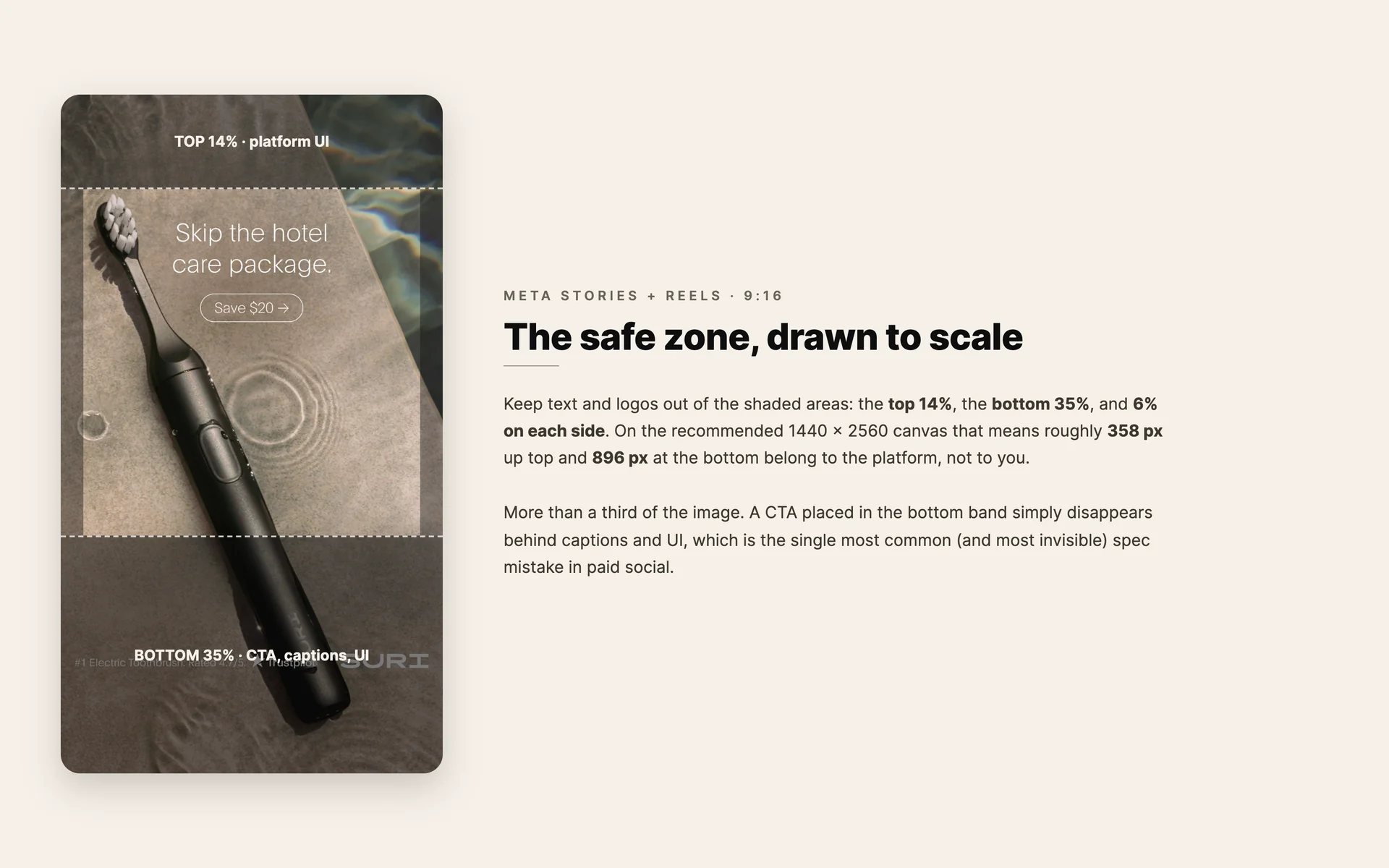
The Meta 9:16 safe zone drawn to scale on a real Stories-ready creative.
Prefer working at 1080 x 1920? Same zones, smaller numbers: about 269 pixels up top, 672 down below, 65 a side. Oh, and one carousel trap while we're in the neighborhood. Meta crops carousel cards square, which means a 4:5 card loses its head and its feet in the deck. Build carousel assets 1:1 from the start and nothing gets guillotined.
Two smaller things buyers rarely hear: a static image in Stories displays for exactly 8 seconds, and Reels placements cut primary text to 44 characters, roughly a third of what Stories allows.
One myth worth burying again since old guides keep exhuming it: the 20% text-on-image rule is dead. Meta removed it years ago. Text-heavy creative can still deliver softer, but nothing rejects it.
LinkedIn, TikTok, and Pinterest
LinkedIn static ad specs
Single image ads take three shapes, and one of them hides a surprise:
- Horizontal: 1200 x 628 (1.91:1), the workhorse
- Square: 1200 x 1200
- Vertical: 720 x 900, mobile placements only
- Files: JPG, PNG or GIF, up to 5 MB
- The surprise: animated GIFs up to 250 frames genuinely play. LinkedIn, of all places, is the one major feed where the image ad type quietly supports motion.
The trap here is copy math. Intro text accepts 3,000 characters and shows about 150. Headlines accept 200 and show 70. With LinkedIn clicks routinely costing north of $10, writing past the fold is a donation, not a strategy.
LinkedIn also keeps a bench of smaller static formats that most spec guides quietly skip. Straight from its ads guide:
- Spotlight ads: 100 x 100 logo, optional 300 x 250 background, 50-character headline
- Follower ads: the same 100 x 100 logo, personalized headline
- Document ads: PDF, DOCX or PPTX, up to 100 MB and 300 pages
- Event ads: a 4:1 image pulled from your event page
None of these replaces the single image ad. But they exist, they have numbers, and now you have them too.
TikTok static ads
Here's the structural surprise: TikTok's main feed has no single static image ad at all. Your static routes in:
- Carousel Ads: 2 to 35 cards at 720 x 1280, 640 x 640, or 1200 x 628; music is mandatory
- Pangle network placements: 9:16, 16:9, or 1:1 static images
- Weight: keep each carousel card near 100 KB, by far the tightest guidance we found anywhere
- Copy bans: no emoji, no "#", no curly braces in descriptions
One unresolved number: the per-card caption limit conflicts between sources, so check it inside Ads Manager rather than trusting any blog, ours included.
Pinterest static ad specs
The pin spec itself is easy. The behaviors are what bite:
- Size: 2:3 at 1000 x 1500, JPG or PNG, 20 MB from desktop
- Truncation: pins taller than 2:4.2 get cut in the feed, so the endless infographic pin sabotages itself in paid
- Descriptions: all 800 characters feed the relevance system; none of them render anywhere a human reads
- Titles: maybe 40 of the allowed 100 characters show before the feed loses interest
- Color: everything re-encodes to 8-bit sRGB JPEG, wide gamut be damned. If your upload looks slightly off, that's not your monitor.
Reddit, X, and Google Display
Reddit static ad specs
Full disclosure: Reddit's official spec page flatly refused to load for us. It's a JavaScript app that resists crawlers, so treat these as strong consensus rather than gospel:
- Sizes: 1080 x 1080 square or 1080 x 1350 at 4:5
- File cap: around a modest 3 MB for single images. The 20 MB you'll see quoted around the web belongs to carousel cards, and the confusion between the two is everywhere
- Titles: 300 characters technically, under 100 per Reddit's own advice, ~80 before mobile cuts
- GIFs: they upload fine, then frequently just sit there as static thumbnails
X (Twitter) static ad specs
One date matters here: February 26, 2026. That's when X started accepting 4:5 and 2:3 creatives, and the company said the quiet part out loud: the whole point was letting advertisers reuse their Meta assets without opening a design tool.
- Ratios: 4:5 and 2:3 (new), plus the existing 1:1, 1.91:1, 16:9 and 9:16, the most format-tolerant feed going
- Files: JPG or PNG to 5 MB; GIFs accepted but usually render static
- Copy: the familiar 280 characters, every URL flat-billed at 23 of them
- Website card headlines: cut at 70 characters
Any spec table written before that February date is stale, and most of them were.
Google Display static ad sizes
Responsive Display Ads take exactly two image shapes. That's the whole menu, and the missing third one surprises people every single time:
- Images: 1200 x 628 landscape and 1200 x 1200 square, up to 15 of them, 5,120 KB apiece
- No portrait slot. The 4:5 asset every social platform now prefers has literally nowhere to go in an RDA
- Text assets: five short headlines at 30 characters, one long headline at 90, five descriptions, 25 characters of business name
Classic uploaded banners live in a different universe entirely: 150 KB caps, fixed sizes, and the ancient 300 x 250 still doing most of the work like it's 2015. The banner slots that still earn their keep:
| Banner workhorse | Size |
|---|---|
| Medium rectangle | 300 x 250 |
| Leaderboard | 728 x 90 |
| Mobile banner | 320 x 50 |
| Wide skyscraper | 160 x 600 |
| Half page | 300 x 600 |
| Billboard | 970 x 250 |
Seven Traps That Crush Static Ad Delivery
- Designing square for Meta feed. The recommendation moved to 4:5 a while ago, and every 1:1 creative you run there leaves a fifth of the vertical space you paid for sitting empty.
- Putting the CTA in the bottom third of a Story. Scroll up to the safe-zone diagram if you skipped it: that band belongs to the UI, and your button simply vanishes behind it.
- Exporting once for everything. Google banners choke at 150 KB while Meta happily takes 30 MB. There is no preset that survives that spread.
- Writing copy to the hard maximum. LinkedIn will politely accept 2,850 characters that no human being will ever see.
- Assuming GIFs animate. Meta converts them into video ads, X and Reddit mostly freeze them, and LinkedIn (of all places) actually plays them. Same file, three fates.
- Reusing the tall Pinterest pin elsewhere. Past 2:4.2 it truncates even on Pinterest itself, and a 2:3 asset fails validation on most other feeds anyway.
- Trusting last year's table. Two of nine platforms changed their core recommendation within twelve months. Check the verification date on any spec guide, including this one.
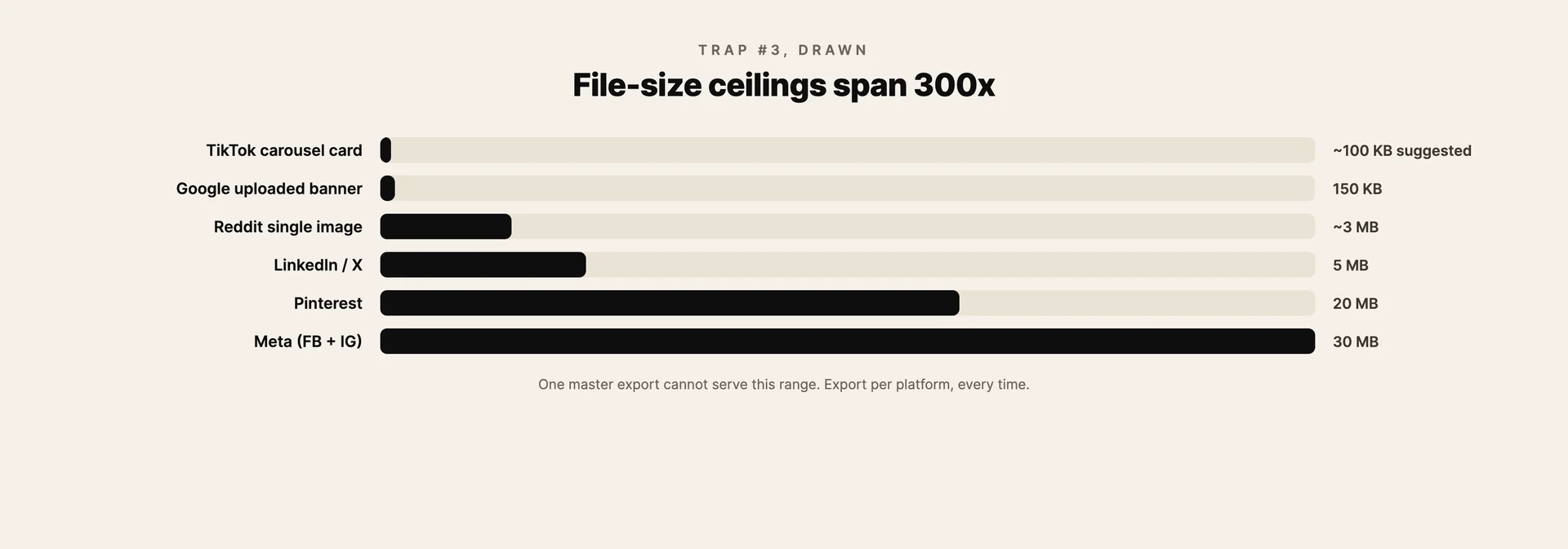
Trap #3 drawn to scale: a 300x spread in what platforms accept.
Generate Every Size at Once
The honest operational answer to a nine-platform spec sheet isn't a designer resizing a master file seven times, because a crop is not a composition. A layout built for 4:5 loses its balance when you guillotine it to 1:1.
In our own workflow the generator builds each ad concept natively in 9:16, 1:1, and 16:9 from the same product input, so every placement gets a layout designed for its ratio. Paste a product link into AskEditor's static ad generator, tick the ratios you buy, and the set arrives sized for the placements above with the copy already baked in.
Frequently Asked Questions
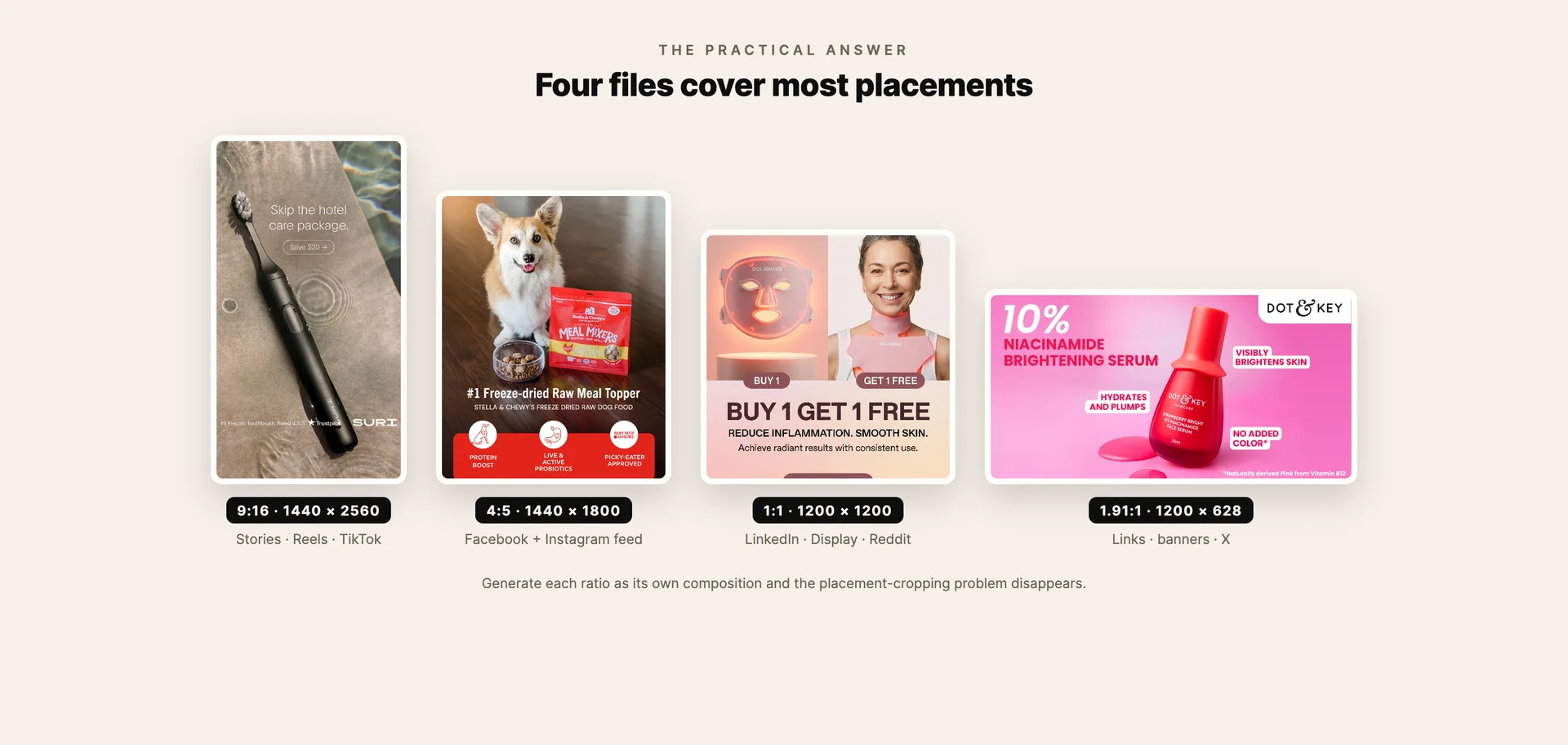
The short version of this entire guide, in four files.
What size should a static ad be in 2026? Start with 1440 x 1800 at 4:5 for Meta feed, then 1440 x 2560 at 9:16 for Stories and Reels. LinkedIn and Google Display want a 1200 x 628 plus a 1200 x 1200 square. Four files, and you have covered the large majority of placements you will actually buy.
What is the best file format for static ads? JPG or PNG works everywhere. PNG suits flat graphics and text-heavy layouts, JPG suits photography, and exporting in sRGB avoids the color shift platforms like Pinterest introduce when they re-encode uploads.
How many characters can a static ad headline have? Wildly platform-dependent, which is the annoying answer but the true one: 27 characters on Facebook feed, 40 on Instagram, about 70 visible on LinkedIn and X cards, and a Reddit title survives to roughly 80 before mobile trims it. Write for the tightest platform you actually buy and the rest take care of themselves.
Do static ads still need different sizes per platform? More than ever. Meta wants 4:5, Pinterest wants 2:3, Google Display refuses portrait entirely. Per-ratio compositions beat crops because crops break layouts that were designed as a whole. And if the real question is which format deserves the budget at all, that argument lives in our static vs dynamic ads guide.
Where do these numbers come from? Each platform's official ad documentation, retrieved July 23, 2026. Where docs were unreachable or self-contradictory (Reddit's file cap, TikTok's carousel captions), we said so and flagged the number as consensus rather than pretending certainty.
Next Steps
Specs are the floor. Clearing them just means your ad is allowed into the auction; what happens next comes down to the hook, the proof, and how many variants you can afford to test.
When you're ready to fill these dimensions with something worth running, paste your product link into AskEditor's static ad generator and get a set sized for every placement above in a few minutes.
AskEditor Team
Guides on making marketing video with AI, from the team building AskEditor.