
HeyGen vs Arcads: The Comparison With Actual Receipts (2026)
HeyGen vs Arcads for AI UGC ads, verified from inside both products: the hidden pricing screens, credit math from their own docs, and the fine print nobody reads.
Most HeyGen vs Arcads comparisons were written by a company that sells a third tool, and it shows. The pricing figures contradict each other from one page to the next, and the one "independent test" ranking for this search was posted by an employee of the tool that conveniently won it.
We did the thing none of those pages did: signed into both products, captured the plan screens and paywalls that neither company publishes, rebuilt the cost math from their own credit documentation, and read every line of both sets of terms. Every claim in this article has a screenshot, a source, and a date behind it.
Full disclosure up front: we build AskEditor, an AI ad platform. It appears in exactly one section near the end, clearly labeled, after the honest HeyGen vs Arcads verdict. There are no affiliate links on this page.
Verdict, July 2026 Arcads is the specialist. If you ship UGC-style Meta and TikTok creatives weekly, its actor library and ad-native workflow are built for exactly that, at $110 a month minimum and roughly eleven times HeyGen's per-minute price. HeyGen is the generalist with the gentler on-ramp: $29 to start, 175+ languages, longer videos, more polish. Neither hands you a finished ad, and that gap is where the third option at the end of this page comes in.
How we verified this
- What we captured: the real plan grids, the paywall behavior, and the actor library gating, from inside both products, in July 2026. The screenshots in this article are ours.
- What we read: both companies' pricing and credit help centers, both terms of service, and both moderation policies, including the parts that contradict their own marketing.
- What we filtered: user reports, cross-checked for astroturfing. Several "independent" comparisons ranking on Google are written by employees or founders of a third tool. We flag the pattern instead of repeating their numbers.
- What we did not do: run a staged one-render "test" and crown a winner from it. Single renders make good-looking content and bad evidence, because output quality on these tools varies more between actors than between products. Here is what the honest version of the quality question looks like.
The output quality question, honestly
Every comparison on page one declares a quality winner, and none of them shows evidence you can check. So instead of adjectives, here is what verifiable sources actually agree on:
- Realism is per-actor, not per-tool. The most credible hands-on review of Arcads found one actor indistinguishable from a human and another with a voice that gave itself away, in the same library, on the same plan. Expect the same spread on HeyGen. Preview the specific actor you plan to use before you budget around it.
- The stylistic split is real and consistent. Across independent reviews, user threads, and both companies' own sample reels, the same pattern repeats: HeyGen output reads polished and presenter-like, Arcads output reads like a phone-shot creator take. Which one is "better" depends entirely on whether your feed placement rewards polish or rawness.
- Judge with your own eyes, free. Both companies publish sample output: HeyGen's avatar library previews play without an account, and Arcads' homepage runs a reel of its actors. Ten minutes with both tells you more than any blogger's verdict, ours included.
- The costly quality problem is retries, not realism. The recurring complaint from paying users on both tools is credits burned on takes with a misread word or an off gesture. That is why the cost table below matters more than a cherry-picked demo: an $11-per-minute tool that needs three takes is a $33-per-minute tool.
The credit math nobody does
The headline prices are $29 a month for HeyGen Creator and roughly $110 a month for Arcads Starter. Those numbers are nearly useless on their own, because both tools meter you in credits, and the credit systems are where buyers get surprised.
Here is the math from the official help centers, verified July 2026:
- HeyGen Creator: $29 buys 600 credits a month. Their newest avatar model burns 20 credits per minute, so 600 credits is about 30 avatar minutes. Just under a dollar per finished minute, if every render is usable.
- Arcads Starter: 8,000 credits a month. A talking actor burns 800 credits per minute per actor, so 8,000 credits is 10 talking-actor minutes. At the $110 we captured on their plan screen, that is about $11 per minute, eleven times HeyGen's rate.
- The honest metric is cost per usable ad, not cost per minute. A cheap minute you re-render four times is not cheap, and neither tool refunds a take you hate. Read your first month's credit meter like a fuel gauge.
Here is what Arcads pricing actually looks like. We signed in and captured the full plan grid from their billing screen on July 24, 2026, because there is no public pricing page to link to:
- Starter, $110 a month: 8,000 credits, 300 actors, up to 600 seconds of avatar talking, 50 AI videos, 74 languages.
- Creator, $220 a month: 16,000 credits, 1,000 actors, 1,200 seconds, 100 AI videos, background removal and AI captions.
- Pro, $550 a month: 40,000 credits, 1,500 actors, API access, ElevenLabs voices, custom actor cloning, team seats.
- Scale $1,100 and Business $2,200 above that, then Custom. Credits never roll over below Pro.
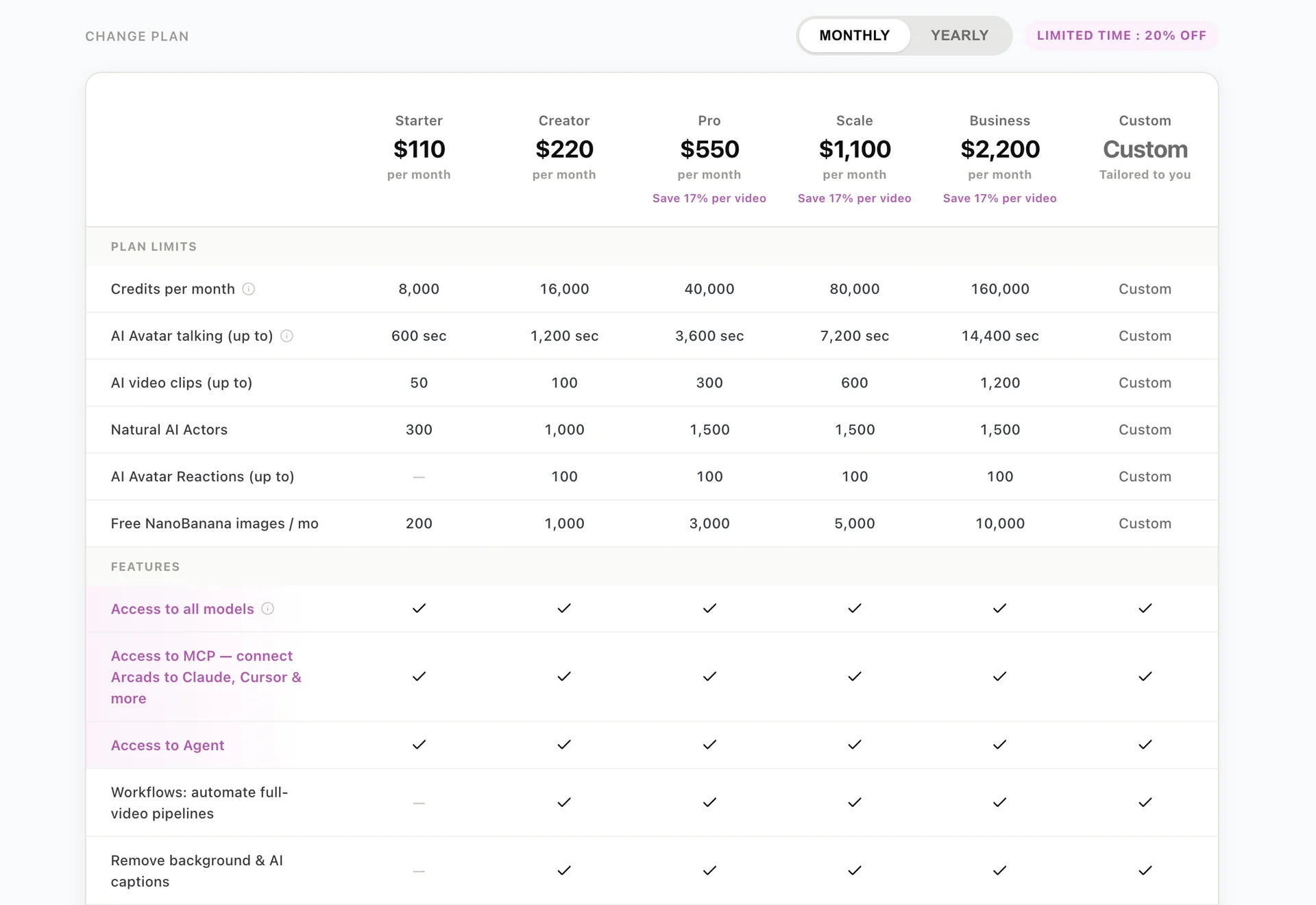 The full Arcads plan grid, captured from inside the product in July 2026. There is no public page where you can see this.
Three things about that grid no comparison page has told you:
- Arcads does not publish any of it. Their public pricing page returns a 404 and the homepage shows no figures. The grid above only appears once you have an account. Every blog quoting "$100" or "$110+" was guessing; some guessed the number, none knew five tiers existed.
- Their own screens disagree with each other. The billing page prices Pro at $550 a month. The upgrade modal that appears when you try to generate calls Pro "Custom" with no figure. Same product, same day, two answers.
- Their docs disagree about credit costs too. One help-center article says one credit per video minute. A newer one says 800 credits per minute. The 800 figure matches the current plans; the old article never got cleaned up. If their documentation confuses you, it is not you.
One more thing we confirmed by trying: a free Arcads account cannot generate anything. We loaded a script, picked an actor, and pressed generate. The upgrade modal appears instantly. No trial render, no watermarked preview, nothing. The first pixel Arcads shows you costs $110.
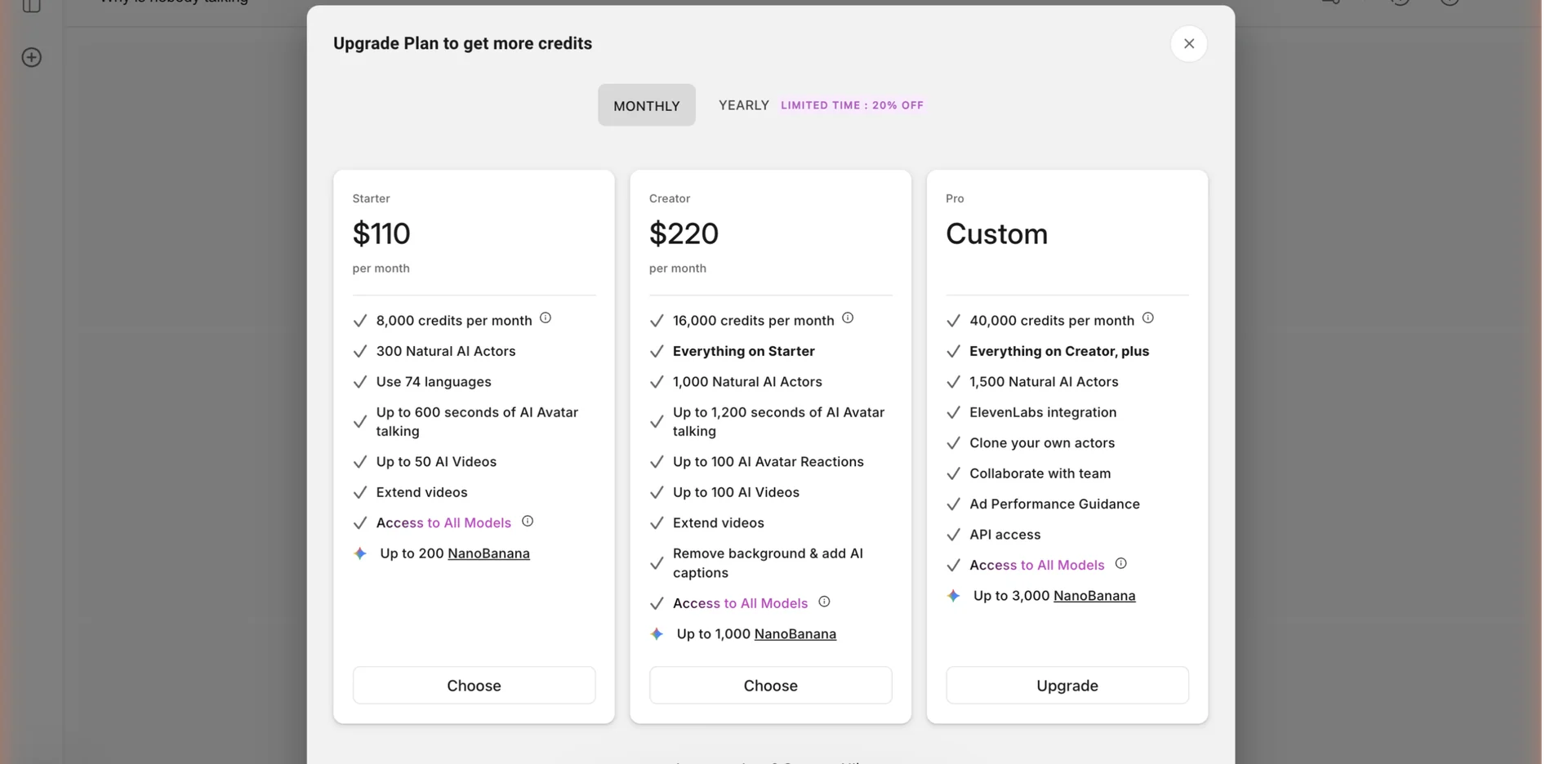 What pressing generate on a free account gets you. Note Pro shown as "Custom" here, while the billing page prices it at $550.
HeyGen has its own asterisk. The word "unlimited" appears in their marketing, and their Trustpilot reviews are full of people who discovered the credit cap afterward. Creator is 600 credits. That is the real number; plan around it.
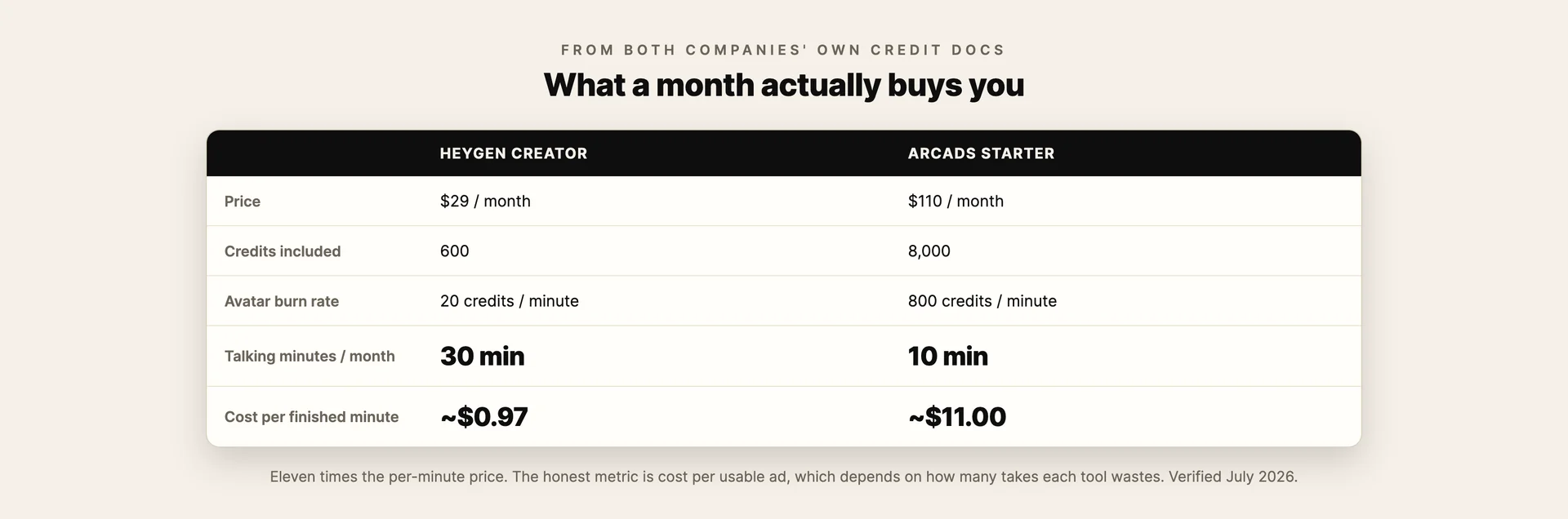 The month-one math from both companies' own credit documentation, July 2026.
What each tool actually is in 2026
Reading the ranking comparisons, you would think these are two versions of the same product. They are not, and both have changed significantly in the last year.
HeyGen is a general AI video platform that added ad features. Avatar V (May 2026) cut most of the uncanny drift, Website-to-Video builds an ad draft from a URL, and the company crossed $200M in annual revenue in June. The library is 700+ stock avatars on paid plans, plus photo avatars and digital twins. Ads are one use case among training videos, sales outreach, and localization; the DNA is polished spokesperson, not shaky-cam UGC.
One update the older comparisons missed: HeyGen's avatar library now has a dedicated UGC category. We browsed it. The category is real, though the avatars in it still read noticeably more studio than Arcads' car-seat-and-couch aesthetic: blazers, office backdrops, good lighting. Whether a HeyGen "UGC" avatar passes as UGC in your actual feed is a judgment call, and it is one you can make yourself in two minutes on their public library, no account needed.
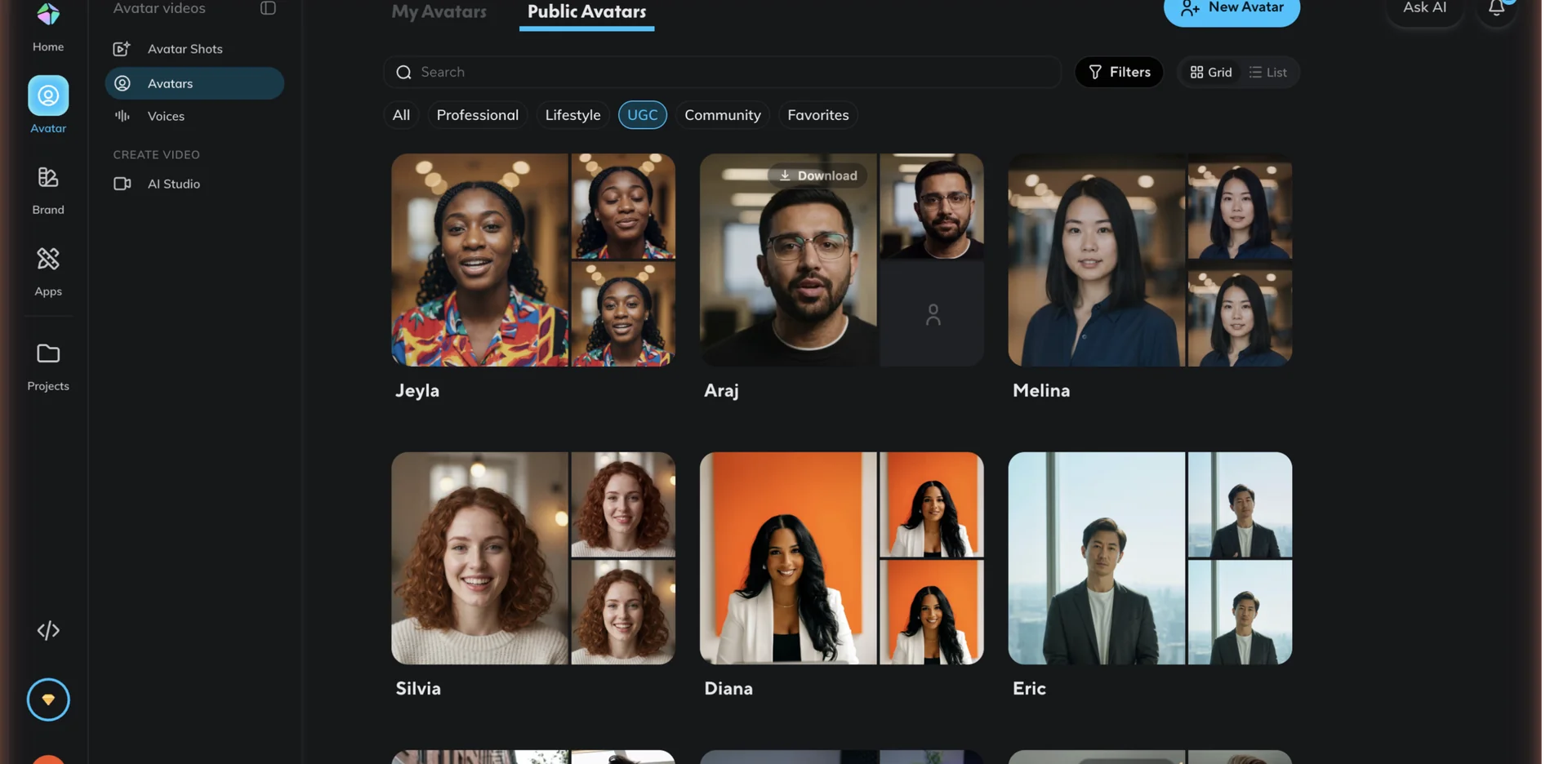 HeyGen's UGC avatar category, July 2026. It exists, which most comparisons have not caught up to. Judge the "UGC-ness" of those backdrops yourself.
While we were inside the product we also caught HeyGen's upgrade banner promising paid videos "up to 5 minutes" while its own pricing page says Creator supports 30-minute videos. Neither number is wrong in context, but the fact that you have to reconcile them yourself tells you something about how both of these companies communicate limits.
 HeyGen's own upgrade banner: "longer videos (up to 5 minutes)." Their pricing page says Creator gets 30-minute videos. Both are HeyGen.
Arcads is a performance-ad machine and nothing else. Arcads 2.0 (December 2025, alongside a $16M raise) turned it from a talking-actor generator into a multi-model creative suite: their own actor engines plus Sora 2 Pro, Kling 3.0, and Veo 3.1 behind one interface, with an infinite-canvas workflow for testing ad variations in batches. Everything about it assumes you are shipping Meta and TikTok creatives weekly.
About that actor library. Half the internet says Arcads has 300+ actors, the other half says 1,000+. Both are right, and that is the part nobody explains: the library is gated by plan. Starter gets 300 actors, Creator gets 1,000, Pro gets 1,500. Inside the actor picker there is literally a filter called "Exclusive For Pro," and when we browsed the most-popular shelf, the second actor listed wore a PRO badge. The Reddit complaint about models you cannot use "unless you upgrade to a tier that is not advertised anywhere" is not paranoia. It is the product working as designed, and you should budget for the tier whose actors you actually want.
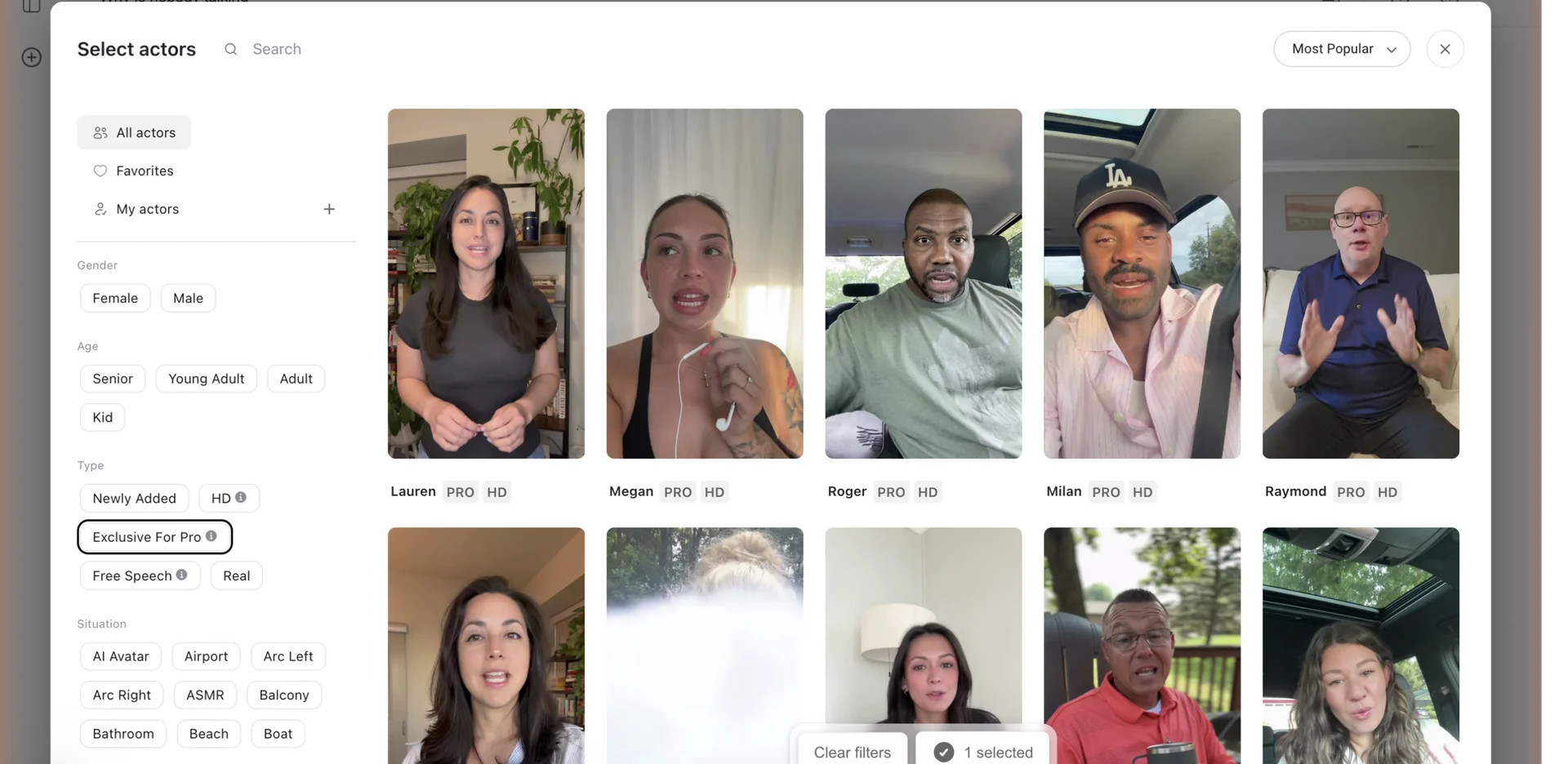 The "Exclusive For Pro" filter inside the Arcads actor picker. These actors appear in everyone's library and generate for no one below Pro.
Languages got the same treatment: their marketing pages say 30+, their help center says "any language," and the upgrade modal inside the product says 74. We are going with 74, since it is the number attached to the plans you actually buy.
The sharpest practical difference is what happens after generation:
- Arcads has no editor. Adding B-roll, music, captions, and transitions is marked "Soon!" on their site as of July 24, 2026. What you download is a raw clip that goes into CapCut or Premiere before it can ship.
- HeyGen has a text-based studio editor, workable for trims and captions, though most ad teams still finish elsewhere.
- Either way, budget for the editing tax when you compare prices. The generation fee is not the whole cost of a finished ad.
Will Meta reject AI avatar ads?
This is the question real buyers ask in every Reddit thread about these tools, and none of the ranking comparisons touch it. The 2026 answer has two parts.
- Detection and labeling are automatic now. Meta applies "AI info" labels using embedded metadata detection, and photorealistic AI people get the more prominent treatment. You should assume your HeyGen or Arcads ad will carry the label.
- The risk is rejection for non-disclosure, not the label itself. Undisclosed AI content is an active ad-rejection reason on Meta as of mid-2026. There is no public Meta data showing the label suppresses delivery; the accounts that get hurt are the ones that try to hide it.
- TikTok is stricter in one specific way: a virtual avatar cannot make first-person experience claims. "I use this every day" from an AI actor is a misleading-content rejection waiting to happen. Script around it: narrate benefits, do not fake testimony.
- Both tools ban political ads outright in their terms, which surprises people every election cycle.
The fine print that costs money
Nobody reads terms of service until a renewal goes wrong. We read both sets so you do not have to. Three findings matter:
- HeyGen's free tier cannot legally run ads. Free-plan output is licensed non-commercial, on top of the watermark. Every "just test it on the free plan" recommendation you have read is telling you to break the license.
- You own HeyGen paid output. You license Arcads output. HeyGen's paid plans grant full ownership. Arcads grants a non-exclusive, non-transferable license, and their terms also license your uploads for training their models.
- Cancellation windows differ sharply. HeyGen cancels at the end of the billing cycle. Arcads requires cancellation at least 72 hours before renewal, and refunds only apply if you used zero credits in the period. Set a calendar reminder the day you subscribe.
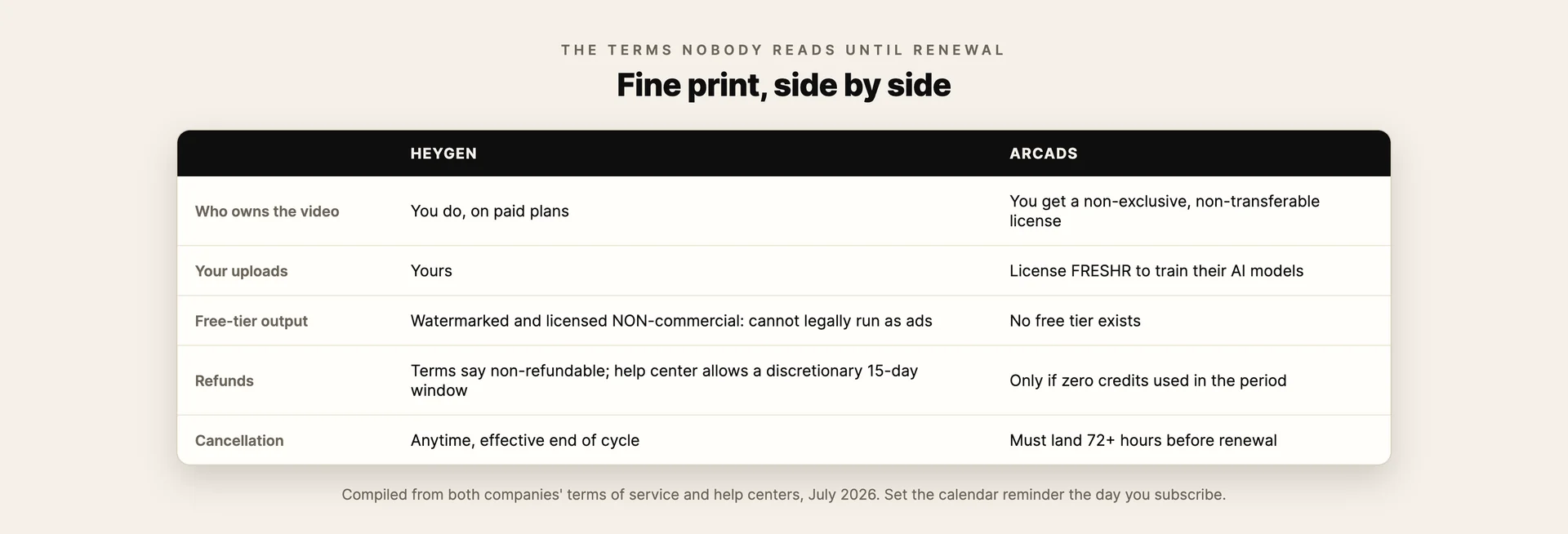 Compiled from both companies' terms and help centers, July 2026.
When to pick each
Pick HeyGen if:
- You need languages. 175+ against Arcads' 74 still is not close, and localization is HeyGen's strongest real-world use case.
- You want a $29 on-ramp before committing real budget.
- Your ads lean polished spokesperson: SaaS explainers, B2B, LinkedIn.
Pick Arcads if:
- You live on Meta and TikTok and need volume: hooks, angles, variations, weekly.
- The casual phone-shot look is the point. This is what their actor library is built for, and it is the thing users consistently praise.
- $110+ a month with no free trial clears your testing budget honestly.
The gap neither fills: both hand you an asset, not a finished ad. If your workflow is generate, then edit, then export, then upload, you are paying for two tools and stitching them together.
Where AskEditor fits
This is our product, so read this section knowing that. We are not going to rank ourselves above the two tools you came here to compare. The structural difference is simpler than a ranking: both HeyGen and Arcads hand you a clip, and AskEditor hands you a finished ad, because generation and a full timeline editor live in one place. Script to UGC-style video, then B-roll, captions, music, and export, without leaving the tool or paying for a second one.
We are not embedding a hand-picked sample here for the same reason we did not stage a one-render test above: a cherry-picked clip proves nothing. Real outputs, made by real users, are on the UGC ads page; judge them the way you judged HeyGen's and Arcads' public reels.
If the editing tax we kept mentioning is the part of this comparison that stung, that is the specific problem AskEditor's UGC ads exists to remove. And if your testing mix includes image ads alongside video, our static ad examples breakdown applies the same receipts treatment to the format nobody films.
FAQ
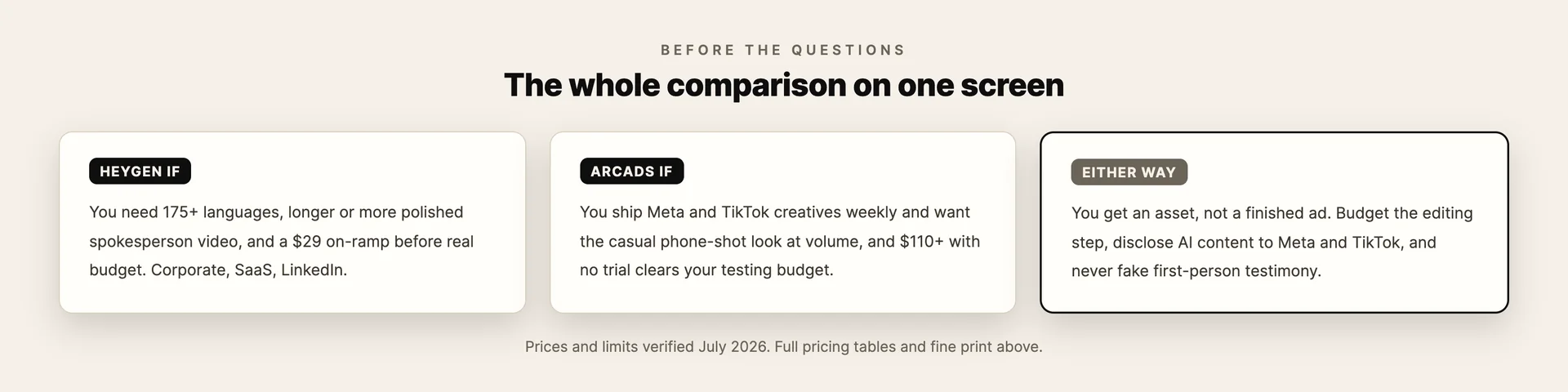 The whole comparison on one screen before the questions.
Is Arcads worth $110 a month?
If you run paid social weekly and the UGC look is your format, the math can work: roughly $11 per talking minute against $200 or more for a single human creator ad. If you are testing casually, the missing free trial and the no-rollover credits make it an expensive experiment. Start cheaper and upgrade when the volume justifies it.
Why does "HeyGen unlimited" have a cap?
The marketing says unlimited videos; the plan meters credits. Creator includes 600 credits a month and the current avatar model burns 20 per minute, which works out to about 30 minutes. Plan around the 600, not the word unlimited. The gap between the two is the most common complaint in HeyGen's reviews.
Can Arcads avatars hold my product?
Both tools officially claim product handling: Arcads lists "avatar holding your product" and HeyGen has Product Placement. Independent hands-on reports say results vary a lot by product type, with digital products easier than physical ones. Run your actual product through whichever tool you trial before you budget around this feature.
Do I have to tell Meta my ad is AI-generated?
Yes, treat it as mandatory. Meta auto-detects and labels AI content, and undisclosed AI is an active rejection reason as of mid-2026. TikTok additionally rejects virtual avatars making first-person experience claims. Disclose, and script around testimony.
Does Arcads have a free trial?
No. We tested it: a free account can load a script and pick an actor, but pressing generate opens the upgrade modal. Refunds after subscribing only apply if you used zero credits in the period, and cancellation must land 72+ hours before renewal.
How many actors does each really have?
Arcads: 300 on Starter, 1,000 on Creator, 1,500 on Pro, confirmed from their own plan grid. The conflicting numbers you see elsewhere are all quoting different tiers without knowing it. HeyGen: 700+ stock avatars on paid plans plus unlimited photo avatars.
Can I use HeyGen's free plan for ads?
No. Free-tier videos are watermarked and licensed strictly non-commercial, which means running them as paid ads breaks the license before it breaks your brand. The $29 Creator tier is the real floor for commercial use.